


The Creative Remedy: What is Creative Public Health and why is it important?

Updated: Jul 22

The arts can help keep us well,
aid our recovery and support longer lives
better lived.
(Creative Health Inquiry Report, 2017)
Creativity is sometimes perceived as an ‘add on’ or ‘nice to have’ for those who are creatively inclined. Sometimes, artistic enterprise is even dismissed as unimportant in favour of other subjects.
However, a significant body of research challenges this assumption. Public health and creative health are linked and it is now recognised that creative expression is a fundamental pillar of preventative healthcare and wellbeing.
In public health, the focus is shifting from solely treating illness to activity preventing it. Taking a holistic approach to prevention requires looking at all of the factors that can prevent ill health.
This is where the concept of Creative Health comes in — defined by the UK's National Centre for Creative Health (NCCH) National Centre for Creative Health as the use of creative and cultural activities to prevent ill-health, manage long-term conditions, and improve overall well-being.
So, what are the benefits of Creative Health?
Preventative Mental Health: Engaging in everyday creative activities (such as painting, craft, writing, or cooking) has been proven to improve emotional regulation, boost self-esteem, and alleviate symptoms of mild-to-moderate depression and anxiety. There is also evidence that creativity can help people who have experienced life trauma.
There is a role for creativity in helping to recover some of the executive brain function that can be lost as a result of trauma and adverse childhood experiences. National Centre for Creative Health Professor Monique Lhussier (Director, Centre for Health and Social Equity, Northumbria University)
Engaging with the arts has a significant part to play in improving physical and mental health and wellbeing. Creative_Health_Inquiry_Report_2017_-_Second_Edition.pdf
Tackling Social Isolation: Group-based creative interventions lower loneliness, which public health bodies classify as a risk factor for cardiovascular disease and cognitive decline. Creative health can also appeal to marginalised groups, who, for various reasons are less inclined to access mainstream health services.
“I think we need creativity in thinking about social change as well as creativity in the nature of people’s lives”. Professor Sir Michael Marmot National Centre for Creative Health
The arts provide a route to better health and wellbeing while health provides a route to the arts that can help to overcome persistent inequalities of access. Creative_Health_Inquiry_Report_2017_-_Second_Edition.pdf
Relieving System Pressure: Clinical trials into social prescribing - where GPs refer patients to community arts groups rather than immediately prescribing medication - have shown a notable reduction in subsequent hospital admissions and GP appointments.
The arts moderate chronic conditions from diabetes to respiratory disease and stroke to dementia.
The pressures now being experienced in health and social care force a search for innovative solutions. (Creative Health Inquiry Report, 2017)
A new APPG for Creative Health was formed in 2025 and you can find information about that here: https://ncch.org.uk/appg-on-creative-health
Flow State

When we participate in creative activities, we often experience a distinct psychological phenomenon known as the Flow State. Coined by psychologist Mihaly Csikszentmihalyi, flow is the state of optimal experience where a person becomes entirely immersed in an activity. You might know it colloquially as being "in the zone".
In the digital age, our attention is constantly fragmented by notifications and multitasking. Cognitive scientists refer to the cognitive drag left behind when switching tasks as attention residue.
Flow is a cognitive state that manifests when there is complete attentional absorption while performing a task. First few seconds for flow: A comprehensive proposal of the neurobiology and neurodynamics of state onset - ScienceDirect
Flow acts as a deep cleanse for your attention span. Because it requires total cognitive absorption, it trains the brain to sustain deep concentration on a singular task, gradually rebuilding our capacity for focus in everyday life.
Flow represents a unique and highly desirable state of consciousness that allows individuals to perform at their highest level of ability. The Neuroscience of ‘Flow’: Understanding Optimal States of Consciousness | Neuroba
The immediate neurological shifts experienced during flow translate directly into long-term psychological benefits.
Being Actively Mindful Unlike passive relaxation (such as watching television, which studies show rarely induces flow), creative activities are active. Engaging in woodwork, knitting, drawing, or playing an instrument, for example, forces an alignment of action and awareness. Because your mind is operating at full capacity on the task at hand, there is no bandwidth left over for worries about the past or anxieties about the future.
You do not need to be a professional artist to reap the public health benefits of creativity. The research emphasises that the process of creating matters far more than the product.
To foster the conditions for flow:
Find what you enjoy and set aside some time to engage: reading, writing, craft, painting, gardening, cooking, pottery - there’s a wide range of options. It doesn’t need to be complicated nor expensive. Try starting with a pen and paper. Set the timer for 3 minutes and just write whatever comes into your head- it doesn’t have to make sense, or hold meaning – the important thing is to ‘brain dump’ and get into the habit of flow writing.
Protect Your Environment: Turn off phone alerts. Distractions break the delicate cognitive ramp-up required to reach deep immersion.
In future blog posts, I will explore some simple writing exercises that can help you to engage your flow state. You can find some examples of my own writing here.

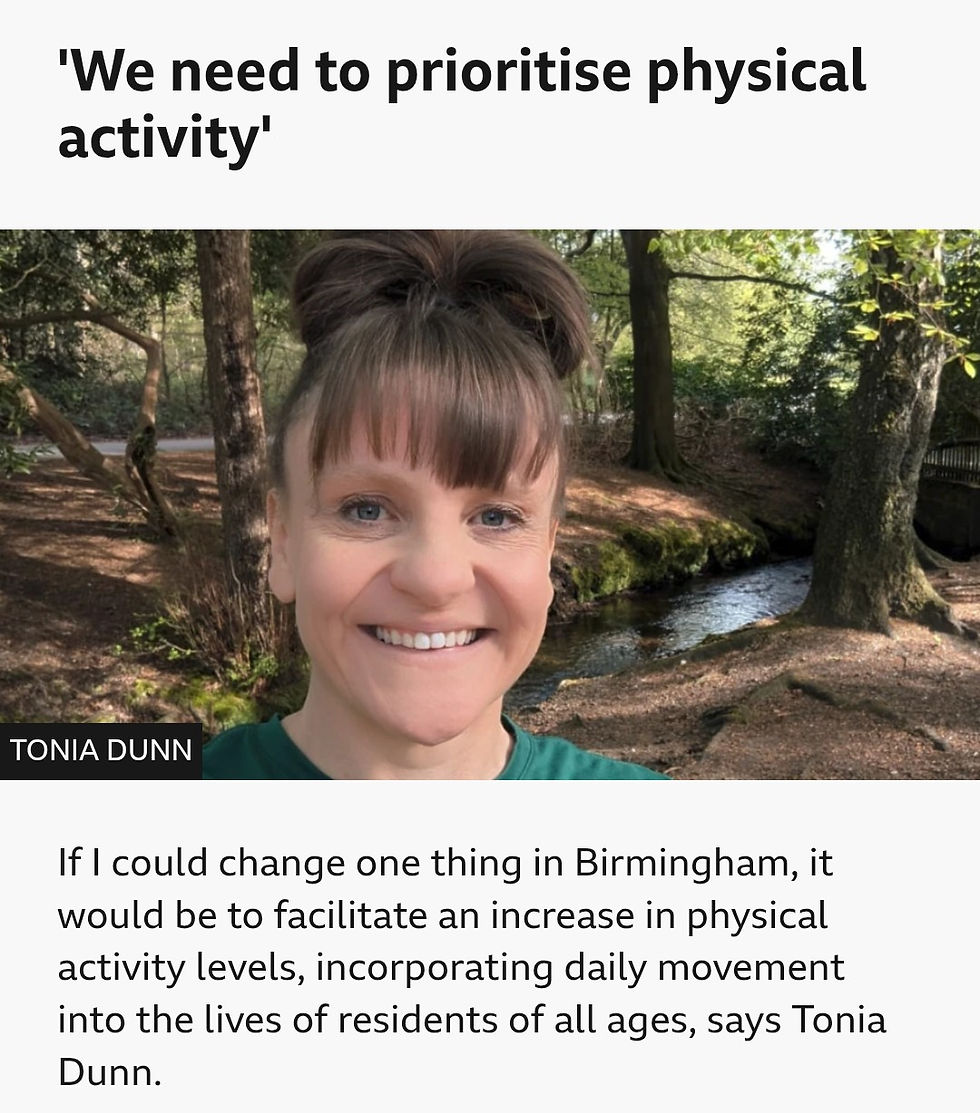
Tonia Dunn has an MA in Creative Writing, is a Health Coach working on the NHS Diabetes Prevention programme in Birmingham, CIMSPA-accredited Advanced Personal Trainer, Associate Member of the Faculty of Public Health, Public Speaker, Boxercise UK Instructor and Mum.
Her creative work has been featured on BBC Upload and across BBC Midlands radio stations.


Comments